Elapsed Time Problems Board Game: Learning Through Play
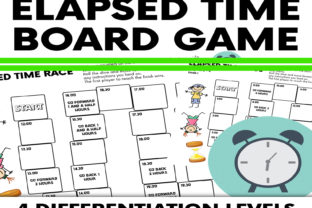
Teaching time concepts doesn’t have to be a chore. The Elapsed Time Problems Board Game makes mastering this essential skill engaging and effective. Designed for 2–4 players, it transforms what could be a dry math lesson into an interactive experience. With just a board, counters, and dice, players roll, move, and solve time-related challenges—without even realizing how much they’re learning.
How the Game Works
The game’s structure is simple yet smart. Each player takes turns rolling the dice and moving their counter along the board. When they land on a square, they must solve an elapsed time problem to determine how many spaces they can advance—or sometimes retreat. This mechanic reinforces problem-solving in a low-pressure environment, making it ideal for learners at different stages.
The game includes four differentiated levels to accommodate varying skill levels:
- Level 1: Hour intervals
- Level 2: Half-hour intervals
- Level 3: Half-hour intervals using the 24-hour clock
- Level 4: 15-minute intervals
This tiered approach ensures that younger students or those new to time concepts can start with the basics, while more advanced learners can tackle real-world scenarios involving precise time increments and 24-hour notation.
Why It Works So Well
One of the standout features of the Elapsed Time Problems Board Game is its ability to blend education with entertainment. Traditional math drills often feel repetitive or intimidating, especially for students who struggle with abstract time concepts. By embedding problems into gameplay, the game reduces anxiety and encourages persistence.
It also promotes collaborative learning. Players can help each other work through problems, reinforcing peer-to-peer teaching and communication skills. Since it’s designed for small groups, it’s perfect for classroom centers, homeschool settings, or even family game nights where learning is subtly integrated into fun.
Applications Beyond the Classroom
While the game was clearly designed with educators in mind, its usefulness extends far beyond school walls. Parents can use it as a screen-free way to reinforce math skills at home. Tutors can integrate it into sessions to break up traditional instruction and provide hands-on reinforcement. Even professionals in training or time-sensitive roles might find value in the 24-hour clock version for brushing up on scheduling or time management basics.
Creatives and content developers working on educational products can also consider this game as a model for designing experiential learning tools. Its structure is adaptable—similar mechanics could be used to teach budgeting, geography, or language skills, making it a versatile template for gamified learning.
Practical Benefits of the Game
From a usability standpoint, the Elapsed Time Problems Board Game is built for accessibility. It requires minimal setup and only a few basic components: a printed board, standard dice, and counters. There’s no need for batteries, apps, or complex instructions—just open the box and play.
Its visual layout helps reinforce time progression in a way that traditional worksheets cannot. Seeing the board move from one time to the next, and physically navigating the timeline, creates a spatial understanding of how time passes. This kind of kinesthetic learning is especially beneficial for visual and tactile learners.
From a design perspective, the game’s aesthetic is clean and focused. It avoids unnecessary distractions, keeping the emphasis on the problems and the gameplay. This simplicity makes it easier to integrate into various learning environments without overwhelming users.
Real-World Use Cases
Here are a few examples of how this game can be applied in different settings:
- Elementary Classrooms: Teachers can use the game as a math center activity, allowing students to practice elapsed time in pairs or small groups while the instructor works with other students.
- Homeschooling: Parents can incorporate the game into a weekly math routine, using it as a break from digital learning tools and a chance to bond with their children over problem-solving.
- Tutoring Sessions: Private tutors can use the game to assess a student’s grasp of time concepts in a less formal setting, identifying areas of strength and weakness through gameplay.
- After-School Programs: Community centers or enrichment programs can set up multiple boards for rotating groups, encouraging teamwork and time-based reasoning in a fun, competitive format.
- Professional Development: In industries where time tracking or scheduling is critical (like logistics or healthcare), a variation of this game could be used to train new employees on time calculations using real-world scenarios.
Choosing the Right Level
One of the most important considerations when using the Elapsed Time Problems Board Game is selecting the appropriate level. Starting too high can lead to frustration, while staying too low may not provide enough challenge to maintain engagement. Here’s a quick guide to help choose the right starting point:
- Level 1: Best for beginners, especially early elementary students learning to tell time and understand the concept of duration.
- Level 2: Ideal for students who can tell time to the hour and half-hour but need practice calculating elapsed time within those intervals.
- Level 3: Perfect for upper elementary or middle school students who are ready to work with 24-hour time notation, often introduced in real-life contexts like travel schedules or military time.
- Level 4: Designed for advanced learners who need precision in time calculations, such as those preparing for standardized tests or real-world applications like cooking, sports, or shift work.
It’s also helpful to rotate through levels as students progress. For example, a classroom might start with Level 1 at the beginning of a time unit and gradually move to Level 4 as students gain confidence and fluency.
Maximizing the Experience
To get the most out of the Elapsed Time Problems Board Game, consider a few enhancements:
- Add a timer: Introduce a time limit for solving each problem to increase the challenge and simulate real-world time pressure.
- Create custom cards: If the included problems become too familiar, design your own based on real-life situations—like figuring out how long a movie marathon will last or when to leave for an appointment.
- Use visual aids: Provide clocks or time number lines to help students visualize the passage of time while solving problems.
- Track progress: Keep a log of how many problems each player solves correctly or how quickly they move through the board. This can help identify growth and areas needing more practice.
These small adjustments can turn a simple board game into a dynamic learning tool that grows with the user.
Final Thoughts
The Elapsed Time Problems Board Game is more than just a classroom activity—it’s a flexible, engaging tool that brings time concepts to life. Whether used by educators, parents, or professionals, it offers a refreshing alternative to traditional drills and digital exercises. By turning learning into play, it fosters deeper understanding, retention, and confidence. If you're looking for a practical, enjoyable way to teach or reinforce elapsed time skills, this game is definitely worth a roll of the dice.