Addition Dice Game for Grades K-1: A Practical Tool for Early Math Development
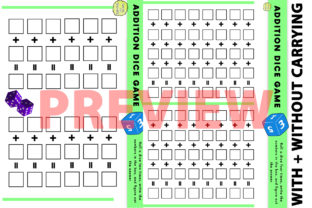
The Addition Dice Game for Grades K-1 is a hands-on, adaptable math activity designed to reinforce basic addition skills through play. This game allows children to roll dice—typically two, three, or four depending on their ability—and add the numbers together. It’s an excellent way to build foundational math fluency, whether students are practicing mentally or using visual aids to support their calculations.
At its core, this activity supports early numeracy by blending repetition with choice. Teachers and parents can easily adjust the difficulty by changing the number of dice rolled or setting specific goals like aiming for the highest or lowest total, fastest completion, or even a target number to reach. These variations make it a flexible tool that can be used across different learning environments and student needs.
How the Addition Dice Game Fits Into a Learning Workflow
When planning a math curriculum for young learners, especially in kindergarten and first grade, integrating engaging, low-prep games like this one can significantly enhance both motivation and retention. The Addition Dice Game for Grades K-1 is not only a standalone lesson but also a valuable extension activity that can be woven into a broader instructional sequence.
- Before a math lesson, use the game as a warm-up to activate prior knowledge and get students thinking numerically.
- During a unit on addition, it can serve as a guided or independent practice station, reinforcing concepts taught through direct instruction.
- After formal instruction, the game becomes a review tool or a fun way to assess understanding informally through observation.
Its adaptability also makes it ideal for differentiated instruction. Struggling learners can use manipulatives or number lines while more advanced students can work with more dice or timed challenges.
Integration with Other Tools and Resources
This dice game works well alongside a variety of educational tools and strategies. It pairs naturally with:
- Visual aids such as number charts, ten frames, or counters for students who need extra support.
- Math journals where students can record their rolls and sums, building writing-to-learn habits.
- Digital math platforms for a blended learning approach, where screen time is balanced with hands-on practice.
- Behavioral incentives like point systems or class rewards based on accuracy or speed.
Because it uses simple materials—dice, paper, and pencils—it’s also easy to integrate into existing classroom routines without requiring extensive preparation or tech access.
Practical Implementation Tips
Here are some strategies to help you incorporate the Addition Dice Game for Grades K-1 effectively into your teaching or home learning routine:
- Start with two dice to build confidence, then gradually introduce more for added challenge.
- Use black and white printable sheets included in the pack to save ink and make copies easy to distribute.
- Set clear goals each session—such as “roll five times and find the highest sum” or “reach a target total in three rolls.”
- Time students occasionally to add an element of urgency and encourage mental math speed.
- Rotate roles when playing in pairs—have one student roll while the other adds, then switch turns.
For educators, consider laminating the game sheets or placing them in dry-erase sleeves to reuse them with different groups or multiple times.
Workflow Examples for Classroom Use
Here’s how you might embed the Addition Dice Game for Grades K-1 into a typical classroom schedule:
- Morning Warm-Up: 10 minutes of dice math to start the day with a math mindset.
- Math Centers: Rotate students through the dice game station every 15–20 minutes.
- Early Finisher Activity: Students who complete their work early can play independently or with a partner.
- Assessment Tool: Use informal observation to note which students are adding mentally and which need visual supports.
This flexibility makes it a reliable tool in both full-group and small-group instruction models.
Factors to Consider for Long-Term Use
When incorporating the Addition Dice Game for Grades K-1 into a long-term teaching strategy, consider these practical factors:
- Preparation: Print and organize game sheets in advance. Consider making a class set and storing them in folders or bins.
- Usability: Ensure dice are clearly marked and durable. Foam dice are ideal for noise control and safety.
- Organization: Label game materials with student instructions to promote independence.
- Consistency: Schedule the game regularly to reinforce skill development without overwhelming students.
- Quality Control: Periodically check for wear on dice and replace as needed to ensure accurate results.
By planning ahead, you can create a seamless experience that supports both student engagement and learning outcomes.
Adapting the Game for Different Learning Goals
While the primary purpose of the Addition Dice Game for Grades K-1 is to build addition fluency, its structure allows for creative adaptations:
- Subtraction Practice: Roll three dice, subtract the smallest from the largest, or subtract one roll from another.
- Comparing Numbers: Students roll two sets and compare the totals using “greater than” or “less than” language.
- Team Challenges: Small groups can compete to reach a cumulative class total over multiple rounds.
These variations extend the game’s usefulness and allow for cross-curricular integration with language and logic skills.
Final Thoughts on Implementation
The Addition Dice Game for Grades K-1 is more than just a game—it’s a versatile, low-prep strategy for building foundational math skills. Whether used as a warm-up, a review tool, or a fun extension activity, it supports early learners in a way that’s both engaging and effective.
For educators and parents, the key is consistency and thoughtful integration into daily or weekly routines. By aligning the game with broader learning goals, adapting it for different learners, and pairing it with complementary tools, you can maximize its impact over time.